Every engineering team over a certain size has performed the same ritual. Open the error tracker. Sort the backlog by some priority score nobody trusts. Fix what fits in the sprint. Then — quietly, quarterly — select all and mark as resolved. The founder of Opslane calls this what it is: bankruptcy. His version happened at Robinhood, against a Sentry backlog, and his product is a bet that the ritual exists because the tool's deliverable was wrong from the start.
An error dashboard delivers awareness. Something threw an exception; here are ten thousand of them, grouped. What a team actually needs is narrower and harder: which bugs are real users hitting right now, and what is the fix. Everything between those two points — triage, reproduction, root-causing, writing the patch — is left as an exercise for whoever is on call. The dashboard was never the deliverable. It was a to-do list wearing a product's clothes.
Two failure modes, one missing input
Error trackers fail in both directions at once. The false positives are famous: thousands of exceptions with no way to tell which ones a user actually felt. The false negatives are worse, because they are invisible: the button that does nothing, the dropdown that closes before anyone can pick from it, the form people silently abandon. None of those throw. No exception, no Sentry issue, no fix — just users leaving.
Catching the second category requires an input error trackers never had: watching what users actually do. That means session recording — not as a growth-team curiosity bolted on for funnel analysis, but as the primary evidence stream for engineering. Rage clicks, dead clicks, and abandonment are bug reports nobody filed.
What a 2026 rebuild looks like
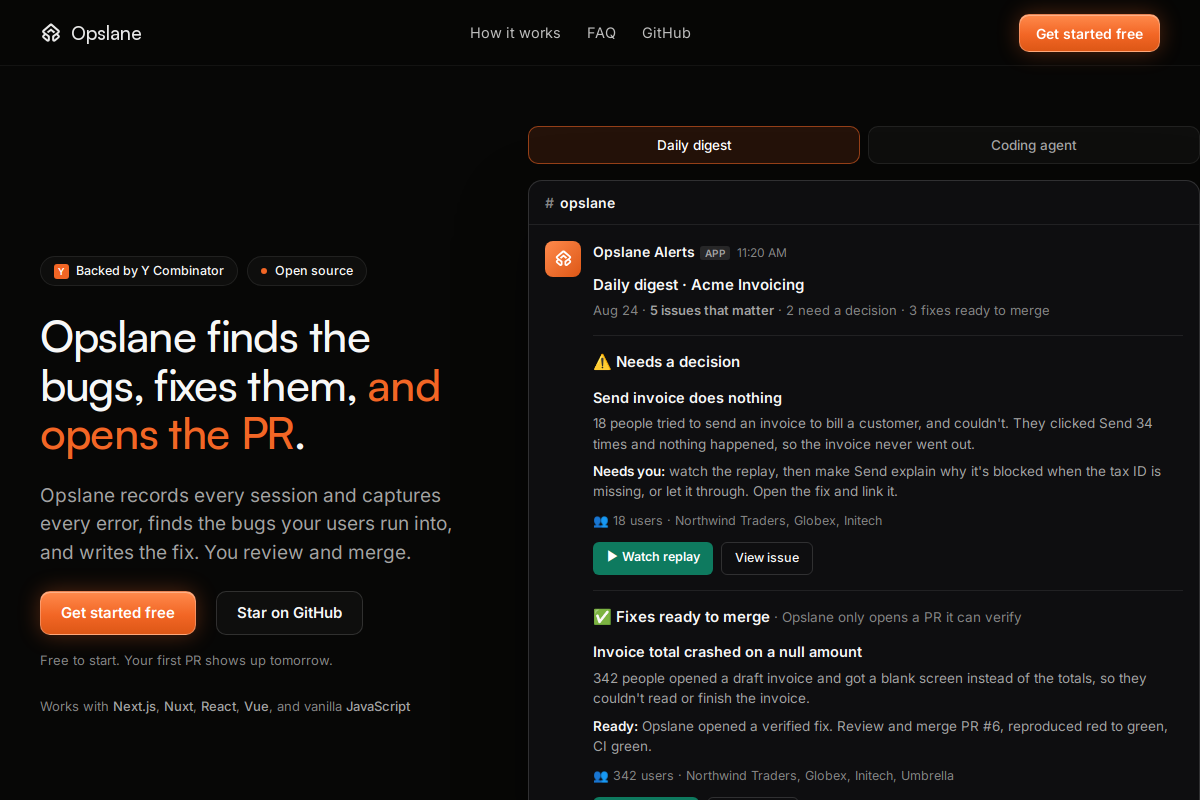
Opslane is the most credible attempt we have opened. The SDK captures errors, console logs, network requests, and session replays, with inputs masked by default. Issues are ranked by how many users hit them. An agent investigates the ones that matter, reproduces the bug in a sandbox, writes a fix — and opens a pull request only when the fix is verified by executed evidence. Not "AI suggests a patch." A PR that reproduced red, went green, and passed the tests, waiting for human review. Runs that cannot reach that bar end in explicit lesser states: an investigation with a root cause, or an incident that says exactly why it stopped.
The daily Slack digest is the interface most teams will actually live in: what broke, what is ready to merge, what needs a product decision. That last category is the subtle one. "Send invoice does nothing when there is no tax ID" is not a code fix — it is a choice about how the product should behave, surfaced with the evidence attached. A tool that knows the difference between a bug and a decision is rarer than it should be.
And because it is 2026, there is an MCP server: your coding agent pulls the digest, reads the investigation, and drives the fix from the terminal. The founder's stated principle is that he never wants to open an error dashboard again. Whatever else is true, the incentives point the right way — the product wins by closing bugs, not by making the backlog look organized.
The caveats that matter
The supported surface is narrow today: browser JavaScript — Next.js, Nuxt, React, Vue, vanilla — with repositories on GitHub. If your bugs live in a Python backend or a mobile app, this is not yet for you. It is open source under MIT and self-hosts from a single Docker Compose file, which matters for anyone hesitant to ship session recordings of their users to a startup's cloud.
And we have not run it against production traffic. The claims that decide whether this is a category shift or a demo — how often the verification holds, what fraction of PRs are mergeable as-is, how noisy the frustration detection runs — can only be answered with real users on a real app. We are saying the design is right, not that the execution is proven. Those are different statements, and a directory that blurs them is advertising.
Sentry still ships, still works, and still ends in the same ritual. If your team's triage genuinely functions, keep it. But if you have ever declared error-tracker bankruptcy — selected all, marked resolved, moved on — the interesting question is no longer how to organize the backlog. It is whether the backlog needed to exist. Run Opslane on something small and low-stakes, and find out what its verification rate is on your codebase before the next bug bash comes around.